
YouTube Loudness Level and 'Stats For Nerds'
In previous years (2019), YouTube used -13 LUFS as its reference level. I adjusted the loudness levels of my videos to approximately -13 LUFS, allowing for a margin of +/-1 dB. (YouTube later lowered this reference level to -14 LUFS.) In other words, as of 2026, YouTube uses -14 LUFS as its target loudness level. When you upload a video, YouTube analyzes its audio and, if the loudness is above this target, it may reduce the playback level.
You can see how YouTube is handling your video's audio using Stats for nerds.
Stats For Nerds
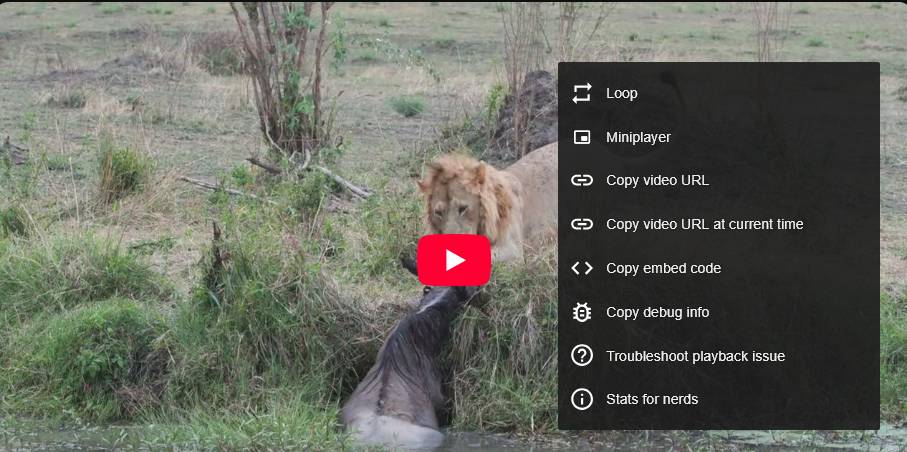
Right-click on the YouTube video and select Stats for nerds from the menu.
A small information window will appear over the video. The audio information can be found in the Volume / Normalized line.
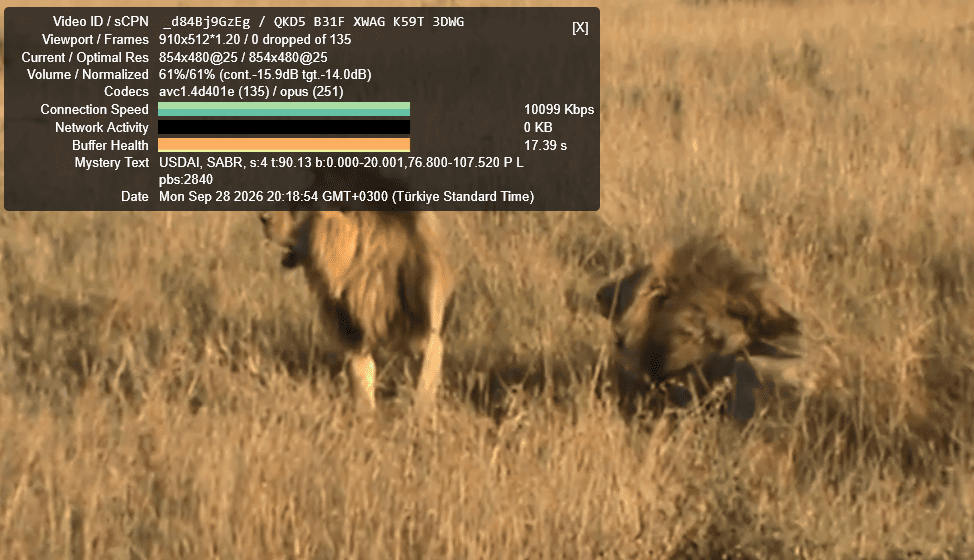
Volume / Normalized
The first percentage is your current player volume. The second percentage shows the normalized playback volume after YouTube's loudness adjustment.
The more important information is now shown in parentheses:
cont. is the video's measured content loudness, while tgt. is YouTube's target loudness.
The difference between these two values tells you how far your video's loudness is from YouTube's target.
2026 Examples
1- Volume / Normalized: 55% / 55% (cont. -17.2 dB tgt. -14.0 dB)
The difference is:
-17.2 - (-14.0) = -3.2 dB
This means the video's audio is 3.2 dB quieter than YouTube's target. YouTube does not boost it to reach the target. If you want the video to play closer to YouTube's target level, you can increase the audio level during recording or editing.
2- Volume / Normalized: 100% / 39% (cont. -5.8 dB tgt. -14.0 dB)
The difference is:
-5.8 - (-14.0) = +8.2 dB
This means the video's audio is 8.2 dB louder than YouTube's target. YouTube therefore reduces the playback level. In this case, you can lower the audio level during recording or editing to avoid such a large reduction.
What Should You Look For?
The easiest way to read the new format is to compare cont. with tgt.:
cont. higher than tgt. : The video is louder than the target and YouTube reduces its playback level.
cont. lower than tgt. :The video is quieter than the target and YouTube does not boost it.
cont. close to tgt. : The video's loudness is close to YouTube's target level.
My Experience
If you are working only with videos that will be published on YouTube, it is useful to consider YouTube's reference level with a margin of +/-1 dB.
However, based on tests I conducted with dozens of different users and their feedback, I found that targeting a loudness level between +1 and +3 dB produced more consistent results among users in practice.
No comments yet. Be the first to comment!